As of 2026, the Samsung Galaxy S26 Ultra stands at the absolute pinnacle of the Android ecosystem, having been released on March 6, 2026. However, its immediate predecessor, the Samsung Galaxy S25 Ultra—released in early 2025—remains a highly capable and formidable device.
The Pricing Paradigm: A Strategic Masterstroke
Perhaps the most startling and widely discussed difference between these two generations of ultra-premium smartphones is Samsung’s aggressive pricing strategy.
When the Galaxy S25 Ultra launched in early 2025, it carried a starting price tag of $1,299.99 in the United States. This pricing was consistent with the upward trend of flagship smartphones over the previous half-decade, justified by the inclusion of a highly expensive Grade 4 Titanium frame, a massive cooling system, and the high costs associated with early-generation 3-nanometer silicon.
In a massive industry shakeup, Samsung shocked the market by launching the Galaxy S26 Ultra at a substantially lower base price of $999.99. This aggressive $300 price reduction for the base model is a deliberate move to undercut Apple’s Pro Max lineup and capture a wider market share of power users. Samsung achieved this price drop not by sacrificing performance, but through optimized manufacturing yields on 3nm processors and a strategic shift in build materials, moving away from expensive titanium to highly refined aluminum without compromising durability. Today, a heavily discounted Galaxy S25 Ultra can be found on the refurbished market for around $750 to $800, but the S26 Ultra’s $999.99 starting price makes the newer flagship incredibly enticing.
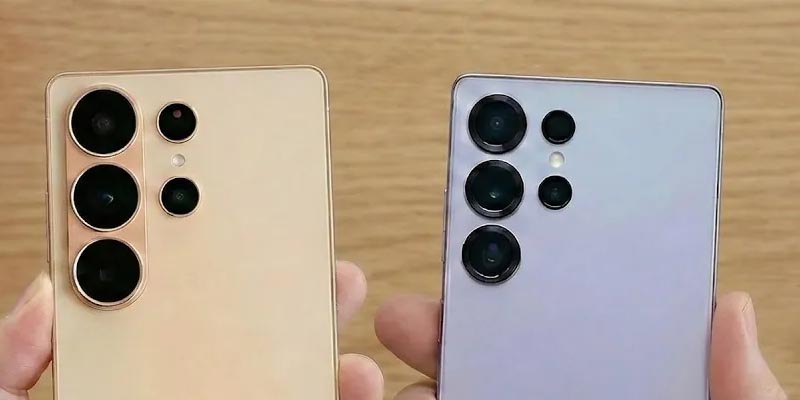
Design and Build Quality: Titanium vs. Armor Aluminum 2
The physical construction of the two devices represents a clear divergence in Samsung’s design language.
The Galaxy S25 Ultra utilized a heavy, luxurious Titanium frame. While this provided exceptional rigidity and a premium, brushed feel in the hand, it resulted in a relatively chunky device. The S25 Ultra was roughly 8.6mm thick and weighed 232 grams. It felt like a solid, unyielding slab of glass and metal, prioritizing robust industrial design.
The Galaxy S26 Ultra pivots entirely. Samsung abandoned titanium in favor of its proprietary Armor Aluminum 2. This aerospace-grade alloy allowed engineers to shave off a massive amount of weight and bulk. The S26 Ultra measures an incredibly sleek 7.9mm in thickness and weighs only 214 grams. Despite being lighter, it maintains the same IP68 water and dust resistance rating. The S26 Ultra also upgraded its front glass to Corning Gorilla Armor 2, offering a Mohs hardness level of 6, a noticeable step up in scratch resistance compared to the S25 Ultra’s first-generation Gorilla Armor.
Display Technology: Pushing the Boundaries of Brightness and Privacy
Samsung displays are historically the best in the industry, and both phones feature stunning, flat OLED panels, but the S26 Ultra brings crucial innovations to the table.
The Galaxy S25 Ultra features a 6.8-inch Dynamic AMOLED 2X display with a peak brightness of 2600 nits. It was highly praised for its color accuracy and the removal of curved edges, which made using the included S Pen significantly more comfortable.
The Galaxy S26 Ultra increases the screen real estate slightly to 6.9 inches by shrinking the bezels to almost imperceptible levels. It pushes a higher resolution of 1440 by 3120 pixels, resulting in an exceptionally crisp ~500 ppi density. While the peak brightness remains similar at 2600 nits, the S26 Ultra introduces “Privacy Display” via Flex Magic Pixel technology. This hardware-level feature restricts viewing angles at the tap of a button, ensuring that sensitive information cannot be read by onlookers—a massive upgrade for enterprise users and commuters that the S25 Ultra lacks.
Performance and Artificial Intelligence
Under the hood, the generational leap in processing power translates directly into vastly improved on-device artificial intelligence capabilities.
The Galaxy S25 Ultra is powered by the Qualcomm Snapdragon 8 Gen 4 (or the first generation of Snapdragon’s 3nm Elite platform, depending on the region). It shipped with 12GB of RAM standard and handled all basic Galaxy AI tasks—such as live translation and generative photo editing—with ease. However, heavier generative AI tasks often required a cloud connection.
The Galaxy S26 Ultra takes a monumental leap forward with the Qualcomm Snapdragon 8 Elite Gen 5 processor. This octa-core chip features two Oryon V3 Phoenix L cores clocked at a blistering 4.74 GHz. More importantly, the Adreno 840 GPU and the vastly upgraded Neural Processing Unit (NPU) are designed specifically for offline, on-device AI. Running Android 16 and One UI 8.5, the S26 Ultra can execute complex Large Language Model (LLM) requests, real-time image upscaling (ProScaler), and advanced contextual Siri-like voice assistance entirely without an internet connection. The S26 Ultra also offers a 1TB storage tier that includes 16GB of RAM, future-proofing it for years of AI advancements.
Camera Systems: Refining the Optics
At first glance, the camera arrays look incredibly similar, but the S26 Ultra brings vital optical refinements, particularly for low-light photography.
The Galaxy S25 Ultra established the baseline with a 200MP primary sensor, a 50MP ultra-wide lens, a 10MP 3x telephoto, and a 50MP 5x periscope telephoto lens. It was widely regarded as the most versatile camera system of 2025.
The Galaxy S26 Ultra retains this exact same megapixel configuration but overhauls the lenses themselves. The massive 200MP primary sensor now features an ultra-wide f/1.4 aperture (upgraded from the S25 Ultra’s f/1.7). This wider aperture allows for a staggering 47% improvement in light intake, drastically reducing noise in night photography and low-light 8K video capture. Additionally, the S26 Ultra utilizes improved multi-directional PDAF and faster sensor readout speeds to virtually eliminate shutter lag—a historical pain point on the S25 Ultra when capturing moving subjects.
Battery Life and Charging Speeds
Both generations feature a large 5,000 mAh battery to power their massive screens and demanding processors, but the S26 Ultra minimizes downtime.
The Galaxy S25 Ultra maxed out at 45W wired charging, which could take the phone from 0 to 65% in about 30 minutes. While adequate, it lagged behind its Chinese competitors.
The Galaxy S26 Ultra finally bridges this gap by introducing 60W Super Fast Charging. This allows the 5,000 mAh battery to reach a 75% charge in just 30 minutes. Furthermore, the newer Snapdragon 8 Elite Gen 5 chip runs significantly cooler, allowing the S26 Ultra to extract roughly 10% to 15% more active screen-on time out of the same battery capacity compared to the S25 Ultra.
Conclusion
The Samsung Galaxy S25 Ultra remains an exceptional piece of hardware, offering a premium titanium build, an incredible display, and a highly versatile camera system. However, the Galaxy S26 Ultra is not just an iterative update; it is a masterclass in market repositioning.
By upgrading to a lighter, thinner chassis, implementing the highly secure Privacy Display, boosting charging speeds to 60W, and enhancing low-light photography with an f/1.4 aperture—all while dropping the entry price from $1,299.99 to an aggressive $999.99—Samsung has created an undeniable value proposition. The Galaxy S26 Ultra is undeniably the superior device, seamlessly blending bleeding-edge AI performance with an accessible price point that completely disrupts the flagship smartphone market.