As of May 2026, the global smartphone market is largely defined by the fierce rivalry between two technological juggernauts: Apple and Samsung. At the absolute pinnacle of their respective lineups sit the Apple iPhone 17 Pro Max and the Samsung Galaxy S26 Ultra. The iPhone 17 Pro Max, which made its highly anticipated debut in September 2025, represented a massive shift for Apple in terms of internal architecture and artificial intelligence integration. Conversely, the Samsung Galaxy S26 Ultra, officially released on March 6, 2026, aims to dominate the ultra-premium Android segment by refining its already class-leading display, camera, and processor capabilities.
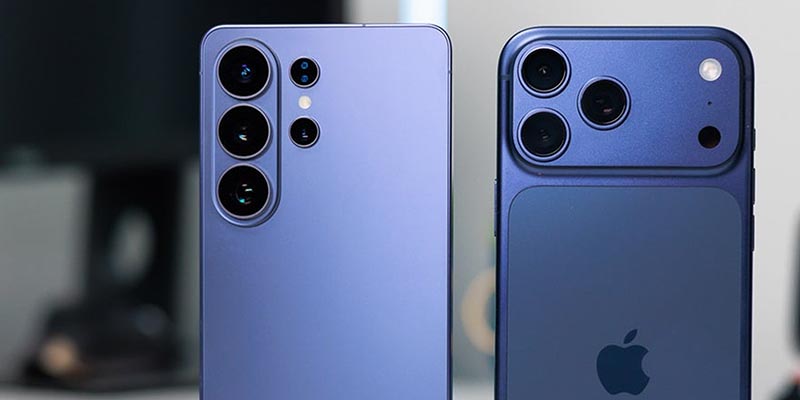
1. Design and Build Quality: Forged for the Future
The aesthetic and structural engineering of both devices highlights their premium positioning, though they take completely different paths to achieve durability and style.
Apple iPhone 17 Pro Max
Apple has moved away from the titanium frame seen in previous generations, opting instead for a striking new unibody design forged from heat-treated aluminum.
- Material and Frame: This heat-treated aluminum is not only stronger but also lighter and far more thermally conductive than older titanium frames, which drastically aids in sustained performance.
- Dimensions and Weight: The device measures 163.4 mm in height, 78 mm in width, and 8.8 mm in thickness. It weighs in at 233 grams, making it slightly thicker and heavier to accommodate a larger internal battery.
- Glass Protection: The front and back of the device are protected by Apple’s Ceramic Shield 2. The front glass provides three times better scratch resistance than previous iterations, while the rear glass offers four times better crack resistance.
- Colorways: The iPhone 17 Pro Max is available in three bold, sophisticated finishes: Deep Blue, Cosmic Orange, and Silver.
- Durability: It retains an IP68 rating, ensuring dust tightness and water resistance for submersion up to 6 meters for 30 minutes.
Samsung Galaxy S26 Ultra
Samsung continues to champion a sharper, more angular design philosophy, catering to power users who value the integration of the S Pen.
- Material and Frame: The Galaxy S26 Ultra features an upgraded Armor Aluminum 2 frame.
- Dimensions and Weight: Samsung’s flagship measures 163.6 mm in height, 78.1 mm in width, and an incredibly thin 7.9 mm in thickness. Despite its large footprint, it weighs a highly manageable 214 grams, making it noticeably lighter and thinner than the iPhone 17 Pro Max.
- Glass Protection: The front glass utilizes Corning Gorilla Armor 2, which boasts a Mohs hardness level of 6, while the back is protected by Gorilla Glass Victus 2.
- Colorways: Samsung offers a wider variety of colors, including Cobalt Violet, Sky Blue, Black, White, Silver Shadow, and Pink Gold.
- Durability: Like the iPhone, the S26 Ultra carries an IP68 rating, though it is rated for submersion up to 1.5 meters for 30 minutes.
2. Display Technology: The Ultimate Visual Canvas
Both smartphones feature massive, industry-leading screens that measure 6.9 inches diagonally. However, the underlying panel technologies and specific features differ significantly.
iPhone 17 Pro Max Display
Apple’s display remains one of the brightest and most color-accurate panels on the market.
- Panel Type: It uses a 6.9-inch Super Retina XDR OLED display with LTPO technology.
- Resolution and Refresh Rate: The screen offers a resolution of 2868 by 1320 pixels at 460 ppi. It features ProMotion technology with an adaptive refresh rate that scales smoothly from 1Hz up to 120Hz.
- Brightness Limits: The display can reach 1000 nits of typical max brightness, 1600 nits peak for HDR content, and a staggering 3000 nits peak brightness for outdoor visibility.
- Special Features: The Dynamic Island has been made narrower than before, and the screen features a nano-texture-like matte finish alongside an anti-reflective coating to drastically reduce glare.
Galaxy S26 Ultra Display
Samsung’s display expertise shines through with incredibly dense pixel counts and innovative privacy features.
- Panel Type: The S26 Ultra is equipped with a 6.9-inch Dynamic LTPO AMOLED 2X display.
- Resolution and Refresh Rate: It boasts a higher resolution than the iPhone, pushing 1440 by 3120 pixels, which translates to an exceptionally crisp ~500 ppi density. The refresh rate similarly scales dynamically up to 120Hz.
- Brightness Limits: While slightly lower in peak outdoor performance than the iPhone, it still outputs an immensely bright 2600 nits peak.
- Special Features: The display incorporates a DX anti-reflective coating. More uniquely, it introduces a “Privacy Display” via Flex Magic Pixel technology, which restricts viewing angles so that sensitive information cannot be easily read by onlookers.
3. Performance and Hardware: Silicon Supremacy
The battle for computational dominance is evident in the custom silicon housed within these devices. Both phones rely on ultra-efficient 3-nanometer processing nodes but utilize radically different architectures.
Apple A19 Pro Chip
The iPhone 17 Pro Max runs on the proprietary Apple A19 Pro chip.
- CPU Architecture:It features a 6-core CPU consisting of two high-performance cores running at 4.26 GHz and four high-efficiency cores running at 2.60 GHz.
- GPU and AI: It houses a 6-core GPU with hardware-accelerated ray tracing and a massive 16-core Neural Engine designed explicitly for generative tasks.
- Memory: Apple has equipped the Pro Max with 12GB of RAM and NVMe storage options ranging from 256GB up to an enormous 2TB capacity.
- Thermal Management: Coupled with the new heat-treated aluminum frame and an internal vapor chamber, the A19 Pro delivers up to 40% better sustained performance than its predecessor, making it highly adept at running Large Language Models (LLMs) locally on the device.
Snapdragon 8 Elite Gen 5
Samsung’s flagship leverages Qualcomm’s bleeding-edge mobile platform.
- CPU Architecture: The S26 Ultra is powered by the Qualcomm Snapdragon 8 Elite Gen 5 built on a 3nm process. This formidable octa-core processor utilizes two Oryon V3 Phoenix L cores clocked at an incredible 4.74 GHz, alongside six Oryon V3 Phoenix M cores running at 3.62 GHz.
- GPU and AI: Graphics are handled by the Adreno 840 GPU running at 1.3GHz, which is engineered to unlock advanced Galaxy AI functionalities.
- Memory: The device ships with a base of 12GB of RAM, but the 1TB storage variant includes a massive 16GB of RAM. Storage uses the ultra-fast UFS 4.X standard.
4. Camera Systems: The Photography Powerhouses
In 2026, smartphone photography goes far beyond simple point-and-shoot mechanics. Both Apple and Samsung have integrated massive sensors and complex optical zoom mechanisms.
iPhone 17 Pro Max Optics
Apple has fully embraced ultra-high-resolution sensors across its entire rear array.
- Main Camera:The primary wide camera uses a 48MP Fusion sensor with an f/1.78 aperture, featuring sensor-shift optical image stabilization (OIS) and dual pixel PDAF.
- Ultra-Wide Camera: The ultra-wide lens has been upgraded to a 48MP sensor with an f/2.2 aperture and a 120-degree field of view.
- Telephoto Camera: Apple utilizes a 48MP tetraprism telephoto lens with an f/2.8 aperture, offering an unprecedented 8x optical zoom and up to 40x digital zoom.
- Video and Selfie:The device can record video in 8K at 30fps and 4K at up to 120fps with Dolby Vision, ProRes RAW, and Apple Log 2. The front features an improved 24MP Center Stage camera (noted in some regions as 18MP multi-aspect) with an f/1.9 aperture.
Galaxy S26 Ultra Optics
Samsung continues to lead the megapixel race while refining its periscope zoom technology.
- Main Camera: The massive primary sensor boasts 200MP with a very wide f/1.4 aperture, multi-directional PDAF, and OIS. This wide aperture allows for a 47% improvement in brightness for low-light video capture.
- Ultra-Wide Camera: It features a 50MP ultra-wide sensor with an f/1.9 aperture and a 120-degree field of view.
- Telephoto Cameras: Samsung employs a dual-telephoto system: a 10MP camera for 3x optical zoom and a 50MP periscope telephoto lens for 5x optical zoom. The S26 Ultra also retains its famous 100x Space Zoom capabilities.
- Video and Selfie: The S26 Ultra records 8K video at up to 30fps and 4K at up to 120fps. The front-facing selfie camera relies on a 12MP sensor with an f/2.2 aperture. Advanced features like Horizon Lock and Best Face are integrated seamlessly into the video suite.
5. Battery Life and Charging: Sustained Endurance
A powerful smartphone is useless without the battery capacity to keep it running throughout a heavy day of usage.
iPhone 17 Pro Max Battery
- Capacity: The iPhone 17 Pro Max houses a 5,088 mAh battery (for eSIM-only models) or a 4,823 mAh battery (for Nano SIM models), representing the largest battery ever placed in an iPhone.
- Endurance:Apple claims this allows for up to 39 hours of offline video playback and 35 hours of streamed video playback.
- Charging: Charging speeds have been heavily bolstered. Using an optional 40W USB-C adapter, users can charge the battery to 50% in just 20 minutes. It also supports 25W MagSafe wireless charging, up to 15W Qi2 wireless charging, and 4.5W reverse wired charging.
Galaxy S26 Ultra Battery
- Capacity: Samsung equips the Galaxy S26 Ultra with a large 5,000 mAh battery.
- Endurance: In structured endurance tests, the S26 Ultra delivers roughly 55 hours of total endurance and over 16 hours of active use time.
- Charging: The Galaxy outpaces the iPhone in raw wired charging wattage, supporting up to 60W Super Fast Charging that can replenish 75% of the battery in just 30 minutes. It also supports 25W fast wireless charging (Qi2.2 standard) and 4.5W reverse wireless charging for powering accessories like earbuds.
6. Connectivity and Network Features
In the modern era, connectivity speeds and protocols are a critical part of the premium smartphone experience. Both Apple and Samsung ensure that their flagship devices are entirely future-proofed.
iPhone 17 Pro Max Connectivity
- Wireless: The iPhone 17 Pro Max features Wi-Fi 7 capabilities, along with Bluetooth 6.0 and an advanced second-generation Ultra Wideband (UWB) chip.
- Networking: It supports comprehensive 5G networks (both sub-6 GHz and mmWave). Furthermore, Apple has redesigned the antenna band surrounding the camera bump to guarantee superior signal reception
- Extras:It continues to feature Emergency SOS, Messages, and Find My capabilities via satellite connections.
Galaxy S26 Ultra Connectivity
- Wireless: Similar to the iPhone, the S26 Ultra supports tri-band Wi-Fi 7 and Bluetooth 6.0. It also includes Ultra Wideband (UWB) support.
- Networking: It fully supports global 5G bands (SA/NSA/Sub6).
- Extras: Samsung heavily pushes its desktop experience ecosystem, outfitting the device with full support for Samsung DeX and Samsung Wireless DeX.
7. Software and Artificial Intelligence Integration
Hardware is only half of the equation; the user experience is ultimately dictated by the operating system and the increasingly important role of artificial intelligence.
iOS 26 and Apple Intelligence
The iPhone 17 Pro Max ships with iOS 26, which is heavily optimized for Apple Intelligence. Apple Intelligence represents Apple’s comprehensive suite of on-device AI tools. Thanks to the massive 17% higher memory bandwidth and the 16-core Neural Engine of the A19 Pro chip, the iPhone can run powerful AI models entirely on-device. This enables advanced, natural writing tools, rapid image generation, deeply contextual Siri enhancements, and features like Audio Mix for professional post-capture sound editing. Furthermore, iOS 26 includes an Adaptive Power Mode that actively learns user habits to dramatically conserve energy over time. Apple promises up to 8 years of consistent software updates for the device.
Android 16 and Galaxy AI
The Galaxy S26 Ultra arrives with Android 16, running under Samsung’s heavily customized One UI 8.5 skin. Samsung has committed to an extraordinary 7 major Android upgrades, ensuring the phone will remain viable well into the 2030s. The Snapdragon 8 Elite Gen 5 processor was specifically customized to unlock the full potential of Galaxy AI. This customized processor utilizes an improved NPU to power features like a real-time image enhancer that dynamically sharpens and smooths visuals across applications. Galaxy AI also drives professional-grade ProScaler upscaling, which ensures flawless color graduation and detailed image processing.
8. Value and Market Positioning
Both smartphones carry pricing that reflects their absolute premium status in the technology sector.
- iPhone 17 Pro Max Pricing: The base model of the iPhone 17 Pro Max launches at roughly $1,239.99 in the United States, €1,210.00 in Europe, and ₹149,900 in India. It explicitly targets professionals, digital creators, and users heavily entrenched in the Apple ecosystem who demand peak video recording capabilities and seamless continuity.
- Galaxy S26 Ultra Pricing: The Samsung Galaxy S26 Ultra undercuts Apple slightly at the entry point, starting at $999.99 in the US, €993.65 in Europe, and ₹121,990 in India. With its integrated S Pen, desktop DeX capabilities, and ultra-high-resolution zoom cameras, Samsung positions the S26 Ultra as the ultimate productivity powerhouse for Android loyalists and power users.
Conclusion
The choice between the Apple iPhone 17 Pro Max and the Samsung Galaxy S26 Ultra in May 2026 represents a decision between two incredibly refined philosophies. Apple’s iPhone 17 Pro Max offers unparalleled battery longevity, an impossibly bright display, and an immense shift toward on-device Apple Intelligence powered by the highly efficient A19 Pro chip. The switch to a heat-treated aluminum unibody and an 8x optical tetraprism lens makes it arguably the most robust digital creation tool on the market.
Conversely, the Samsung Galaxy S26 Ultra fights back with extreme versatility. Its 200MP primary sensor, coupled with a secondary 50MP periscope lens, offers a level of photographic flexibility that is difficult to rival. With incredibly fast 60W charging, the inclusion of the S Pen, and cutting-edge features like the Privacy Display, the Galaxy S26 Ultra remains the undisputed champion for multitasking and raw, unfettered hardware innovation. Both devices stand as monumental achievements in mobile engineering, pushing the boundaries of what consumers can expect from a handheld computer in 2026.