iPhone Ultra (Fold) 2026 Review: Specs, Price, and Features
The smartphone industry has been holding its breath for years, waiting for the Cupertino giant to officially enter the foldable arena. While competitors have been iterating on folding displays for several generations, Apple has characteristically played the long game, waiting for the technology to mature. Based on the latest preliminary specifications, the wait might finally be over in 2026. Previously rumored as the “iPhone Fold,” the upcoming Apple iPhone Ultra is poised to completely disrupt the premium mobile market.
This comprehensive review dives deep into the rumored specifications, design architecture, performance metrics, and the astronomical expectations surrounding the Apple iPhone Ultra. From its impossibly thin amorphous alloy frame to its groundbreaking self-healing display technology, here is everything you need to know about what could be the most significant leap in iPhone history.
iPhone Ultra (Fold) 2026 Specs
| Category | Specifications & Details |
| Device Name | Apple iPhone Ultra (previously rumored as iPhone Fold) |
| Expected Release | 2026 |
| Price (Estimated) | ~2200 EUR (Approx. $2,300 – $2,400 USD) |
| Form Factor | Book-style Foldable Smartphone |
| Dimensions | Unfolded: 120.6 x 167.6 x 4.7 mm
Folded: 120.6 x 83.8 x 9.2 mm |
| Build Materials | Ultra-durable Amorphous Alloy frame; Ceramic Shield front; Side-mounted fingerprint sensor |
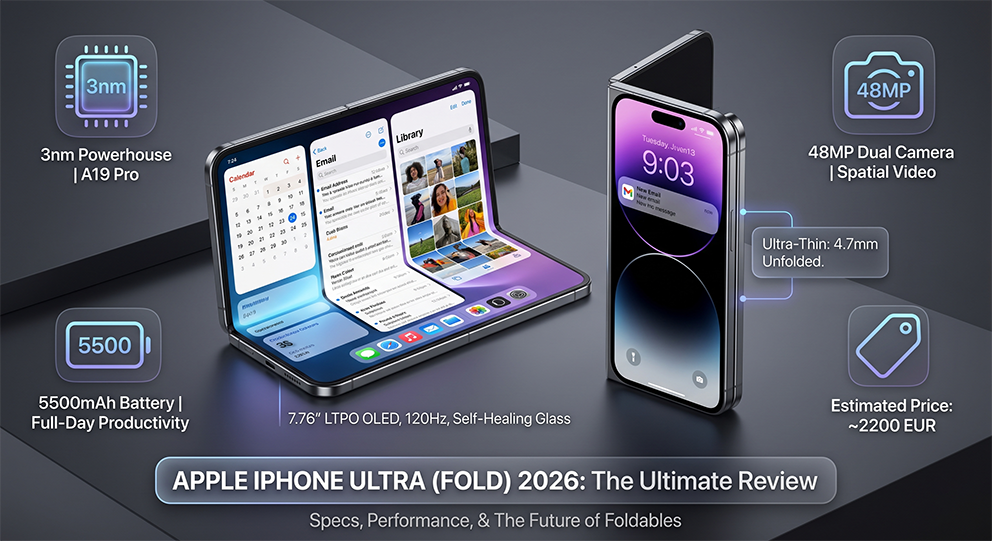
| Inner Display | 7.76″ Foldable LTPO OLED (1920 x 2713), 120Hz, HDR10+, Self-healing memory glass technology |
| Cover Display | 5.49″ LTPO OLED (1422 x 2088), 120Hz, Ceramic Shield |
| Processor | Next-generation 3nm Apple Silicon (likely A19/A20 Pro) |
| Memory (RAM) | 12GB RAM (optimized for heavy multitasking) |
| Storage Options | 256GB, 512GB, 1TB NVMe (No expandable storage) |
| Main Camera System | Dual Setup: 48 MP Wide (sensor-shift OIS) + 48 MP Ultrawide |
| Video Capabilities | Up to 4K@120fps, ProRes, Dolby Vision HDR, 3D Spatial Video/Audio |
| Selfie/Cover Cameras | 18 MP multi-aspect Ultrawide (one on inner screen, one on cover) |
| Battery & Charging | 5500 mAh, USB Type-C wired charging |
| Connectivity | Wi-Fi 7, Bluetooth 5.3, Ultra Wideband (UWB) gen2, Emergency SOS/Messaging via Satellite |
| Target Audience | Digital creators, power users, and premium tech enthusiasts needing an ultra-portable productivity canvas. |
Design and Build Quality: Engineering the Impossible
Apple has always prided itself on industrial design, but the iPhone Ultra represents a masterclass in materials science and structural engineering. The leaked dimensions are nothing short of staggering. When unfolded, the device measures an incredibly thin 120.6 x 167.6 x 4.7 mm. To put that 4.7mm thickness into perspective, it is significantly thinner than almost any slab smartphone on the market today. When folded, it sits at a highly manageable 9.2mm, completely eliminating the bulky, brick-like feel that has plagued early foldable devices from other manufacturers.
To achieve this extreme thinness without compromising structural integrity, Apple is reportedly utilizing an “Amorphous Alloy” frame. Often referred to as liquid metal, amorphous alloys offer significantly higher yield strength and elastic limits compared to traditional aluminum or even titanium. This means the iPhone Ultra will be exceptionally resistant to bending, denting, and scratching—crucial for a device with a complex hinge mechanism.
Furthermore, the introduction of a side-mounted fingerprint sensor marks a pragmatic shift. While Face ID has been the standard for years, a side-mounted biometric scanner ensures seamless unlocking whether the device is folded or unfolded, providing an ergonomic solution tailored specifically to the foldable form factor.
The Displays: A Canvas for Digital Creation
For digital content creators, mobile marketers, and media enthusiasts, the display is the most critical component of any smartphone. The iPhone Ultra delivers a dual-screen experience that promises to be visually spectacular.
The Inner Unfolded Display: Opening the device reveals a massive 7.76-inch foldable LTPO OLED display with a resolution of 1920 x 2713 pixels. This translates to a dense ~428 ppi, ensuring razor-sharp text, incredibly detailed image rendering, and a pristine canvas for reviewing ultra-high-definition digital promotional materials, thumbnails, and marketing posters. With a ~90.6% screen-to-body ratio, the bezels are practically non-existent.
The 120Hz refresh rate combined with HDR10+ support guarantees fluid animations and staggering color accuracy. However, the most revolutionary aspect of the inner display is the “self-healing memory glass technology.” One of the biggest historical drawbacks of foldables has been the delicate nature of the inner screen and the inevitable crease. Apple’s self-healing technology aims to mitigate micro-scratches over time, while the engineering of the hinge promises a “small display crease” that is virtually imperceptible during daily use.
The Cover Display: When folded, users interact with a 5.49-inch LTPO OLED cover display boasting a 1422 x 2088 pixel resolution. Protected by Apple’s renowned Ceramic Shield glass, this outer screen doesn’t feel like a compromise. It retains the 120Hz refresh rate, ensuring that the transition between the folded and unfolded states feels completely frictionless. It is perfectly sized for one-handed operation, quick messaging, and rapid photography.
Performance and Hardware: The 3nm Powerhouse
Under the hood, the iPhone Ultra is powered by an ultra-efficient 3nm chipset. Given the expected 2026 announcement, this will likely be the A19 or A20 Pro chip, representing the absolute pinnacle of mobile processing power. The move to a 3nm fabrication process allows for a massive increase in transistor density, delivering exponential gains in both CPU speed and thermal efficiency.
Apple is pairing this cutting-edge silicon with a whopping 12GB of RAM. For a company that traditionally optimizes its software to run on much less memory than its Android counterparts, 12GB of RAM in an iOS device is monstrous. This is specifically designed to handle the intense multitasking demands of a tablet-sized foldable interface. Users will be able to run multiple heavy applications side-by-side—such as editing high-resolution images in Lightroom, exporting 4K video, and managing SEO-optimized web content simultaneously—without a single stutter.
Storage options are distinctly premium, abandoning lower capacities entirely. The iPhone Ultra will be available in 256GB, 512GB, and 1TB NVMe configurations. True to Apple’s philosophy, there is no expandable card slot, so users intending to store massive libraries of ProRes video or spatial audio will need to invest in the higher storage tiers.
Camera System: Spatial Video and Pro-Level Photography
While the rumored camera specifications are noted as illustrative preliminary details, they paint a picture of a no-compromise optical system designed for serious creators.
The Main Array: The primary shooter is a 48 MP wide lens (f/1.8, 24mm) with a large 1/1.28″ sensor, 1.22µm pixels, dual pixel PDAF, and sensor-shift Optical Image Stabilization (OIS). This massive sensor will capture incredible light, resulting in unparalleled low-light performance and natural depth of field. It is paired with a 48 MP ultrawide lens (f/2.2, 13mm) featuring PDAF, ensuring landscape shots and architectural photography are just as detailed as the main sensor.
Video Capabilities: Apple has always dominated the mobile video landscape, and the iPhone Ultra pushes this further. It supports 4K recording up to a blistering 120fps, and 1080p slow-motion up to 240fps. The inclusion of 10-bit HDR, Dolby Vision HDR, and ProRes support makes this a literal cinema camera that folds into your pocket. Most importantly, the camera array supports 3D Spatial Video and Audio recording, allowing users to caUpgrade Nowpture immersive memories and content specifically designed to be viewed on augmented reality headsets like the Apple Vision Pro.
Selfie and Cover Cameras: For front-facing content, both the inner and cover screens house an 18 MP multi-aspect ultrawide camera (f/1.9, 20mm) with PDAF. These cameras support 4K recording up to 60fps and gyro-EIS, making them perfect for high-quality vlogging, video conferencing, and live streaming.
Battery, Charging, and Connectivity
Powering a 7.76-inch 120Hz display and a 3nm processor requires serious juice, and Apple is stepping up with a massive 5500 mAh battery. This is one of the largest batteries ever placed in an iPhone. Combined with the high energy efficiency of the LTPO displays and the 3nm chipset, the iPhone Ultra is projected to easily deliver multi-day battery life under normal use, or a full day of heavy, uninterrupted content creation.
The device features a USB Type-C port, fully embracing universal charging standards and allowing for rapid data transfer speeds essential for offloading large ProRes files.
On the connectivity front, the iPhone Ultra is heavily future-proofed. It features Wi-Fi 7 (802.11 a/b/g/n/ac/6e/7) with tri-band support, ensuring the fastest and most stable wireless internet speeds available. Bluetooth 5.3, ultra-wideband (UWB) support via a gen2 chip, and a comprehensive suite of positioning satellites (GPS, GLONASS, GALILEO, BDS, QZSS, NavIC) round out the package. Notably, it also includes Apple’s life-saving Emergency SOS, Messages, and Find My capabilities via satellite, ensuring you remain connected even completely off the grid.
Software: iOS Evolved
Hardware is only half the story; software dictates the experience. By 2026, iOS will have undergone significant evolutions to natively support the foldable form factor. We can expect advanced multitasking capabilities, seamless app continuity when moving from the cover screen to the main display, and optimized first-party apps that utilize the 7.76-inch canvas effectively. Features like split-screen views, floating windows, and drag-and-drop functionality will turn the iPhone Ultra into a bona fide productivity powerhouse.
Pricing Guide and Market Analysis
Innovation of this magnitude comes at a steep premium. The expected price tag for the Apple iPhone Ultra is hovering around 2200 EUR (roughly $2,300 to $2,400 USD depending on conversion and regional taxes).
While this establishes the device in an ultra-premium, luxury tech tier, it aligns perfectly with the market positioning of top-tier foldables. Buyers are essentially purchasing a high-end smartphone and an iPad Mini seamlessly fused into one device. For mobile professionals, tech enthusiasts, and digital creators who require the absolute best technology for productivity and media consumption, the high cost of entry is an investment into an unparalleled mobile workflow. The lack of lower storage tiers (starting at a minimum of 256GB) further cements this as a device built for power users.
Final Verdict: The Future is Folding
The rumored Apple iPhone Ultra is not just another smartphone; it is a declaration of intent from Apple. By waiting until 2026, Apple has given itself the runway to solve the glaring issues that plagued first-generation foldables—namely crease visibility, battery life, and physical bulk.
With its ridiculously thin 4.7mm unfolded profile, incredibly robust amorphous alloy frame, massive 5500 mAh battery, and the sheer processing might of a 3nm chip paired with 12GB of RAM, the iPhone Ultra is shaping up to be an absolute masterpiece of modern engineering.
For those who demand the ultimate digital canvas, unparalleled camera performance for spatial video, and the prestige of Apple’s flagship ecosystem, the iPhone Ultra looks perfectly positioned to completely dominate the foldable market upon its release. It is a highly ambitious piece of technology that justifies its ultra-premium pricing, redefining what we can expect from the smartphone of the future.