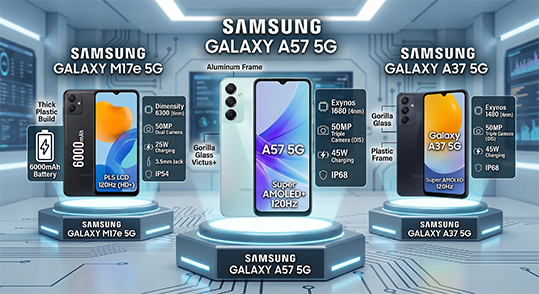
Samsung Galaxy A57 5G | Galaxy A37 5G | Galaxy M17e 5G Specs and features
The smartphone landscape in 2026 continues to be highly competitive, and Samsung’s strategy of offering a finely tuned device for every conceivable price point remains as aggressive as ever. Looking closely at the newly released Samsung Galaxy A57 5G, Galaxy A37 5G, and Galaxy M17e 5G, we can see a clear segmentation tailored to vastly different user priorities. Released in March and April of 2026, these three devices showcase Samsung’s nuanced approach to the premium mid-range tier, the standard mid-range segment, and the budget-conscious, battery-focused market. While they all share the iconic “Galaxy” moniker and boast 5G capabilities, a deep dive into their specifications reveals stark differences in build quality, processing power, display technology, camera prowess, and overall daily utility. This comprehensive breakdown will compare these three models across all major categories to illustrate exactly what separates them.
Design, Build Quality, and Durability
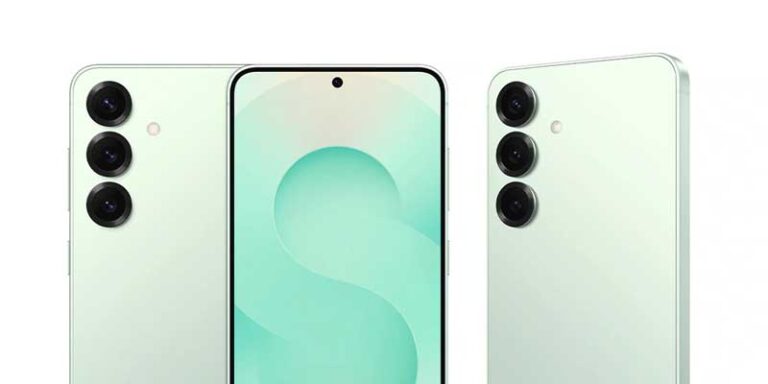
The physical construction of a smartphone is often the first indicator of its price tier, and Samsung has distinctly separated these three models through their materials and dimensions. The Galaxy A57 5G is the undisputed premium offering of the trio. It boasts a remarkably slim profile at just 6.9mm thick and weighs a manageable 179 grams. Furthermore, it utilizes an aluminum frame sandwiched between Corning Gorilla Glass Victus+ on both the front and back. This combination not only provides flagship-level drop and scratch resistance but also delivers a premium, cold-to-the-touch feel in the hand.
The Galaxy A37 5G sits slightly below the A57. While it retains the excellent Gorilla Glass Victus+ on both its display and rear panel, it swaps the aluminum frame for a plastic one. This change makes it slightly thicker at 7.4mm and noticeably heavier at 196 grams, though it still feels incredibly robust. Both the A57 and A37 feature an IP68 rating, ensuring they are completely dust-tight and can survive submersion in 1.5 meters of water for up to 30 minutes.
In stark contrast, the Galaxy M17e 5G is built entirely with utility and cost-savings in mind. It is the thickest and heaviest of the bunch at 8.2mm and 199 grams, which is largely necessary to house its massive battery. It features a plastic back and a plastic frame, and steps down to a basic IP54 rating. This means it is protected against dust and minor water splashes, but it cannot survive being dropped in a pool.
Display Technology and Viewing Experience
All three smartphones feature expansive 6.7-inch displays, but the underlying technologies create vastly different viewing experiences. The Galaxy A57 5G and A37 5G both utilize stunning 1080 x 2340 pixel resolution panels with a smooth 120Hz refresh rate. They both achieve a blindingly bright 1900 nits of peak brightness, ensuring perfect legibility even under direct, harsh sunlight. The A57 edges out a slight victory by using a “Super AMOLED+” panel compared to the standard “Super AMOLED” on the A37, and by achieving a slightly higher screen-to-body ratio (88.8% vs 86.5%), meaning its bezels are noticeably thinner.
The Galaxy M17e 5G, keeping its budget nature in mind, cuts significant corners in the display department. It uses a PLS LCD panel instead of OLED, which means colors won’t be as vibrant and blacks won’t be perfectly deep. More importantly, the resolution drops to 720 x 1600 pixels (HD+). Stretched across a 6.7-inch canvas, this results in a pixel density of roughly 262 ppi, which will look noticeably softer and less sharp than the ~385 ppi of the A-series phones. While it retains a smooth 120Hz refresh rate, its peak brightness caps out at 800 nits, which will make outdoor viewing on a sunny day somewhat challenging.
Performance, Memory, and Software Longevity
Under the hood, the performance delta between these devices is substantial. The Galaxy A57 5G is powered by the modern 4nm Exynos 1680 chipset, utilizing newer Cortex-720 performance cores. Combined with incredibly fast UFS 3.1 storage and up to 12GB of RAM, this device is built to handle heavy multitasking, high-end mobile gaming, and intensive background processing without breaking a sweat.
The Galaxy A37 5G steps down to the 4nm Exynos 1480, which utilizes older Cortex-A78 cores. While still highly capable and highly efficient, it won’t match the raw graphical or processing headroom of the A57. It also offers configurations starting at 6GB of RAM, compared to the A57’s 8GB baseline.
The Galaxy M17e 5G is powered by the Mediatek Dimensity 6300, a 6nm chipset designed for basic efficiency rather than high performance. With RAM options limited to 4GB or 6GB, the M17e is strictly meant for everyday tasks like social media browsing, video streaming, and light web navigation.
Remarkably, despite their hardware differences, Samsung is offering an industry-leading software commitment across the board. All three phones launch with Android 16 and are guaranteed up to 6 major Android upgrades. This is an incredible value add, particularly for the budget M17e, ensuring the phone will remain secure and up-to-date well into the 2030s.
Camera Systems and Photography
The camera systems further illustrate the price hierarchy. Both the A57 and A37 feature 50MP primary sensors with Optical Image Stabilization (OIS) and Phase Detection Autofocus (PDAF). OIS is crucial for capturing sharp photos in low light and recording smooth video. However, the A57 boasts a larger 1/1.56″ sensor compared to the A-series average, allowing more light to enter the lens. The A57 also includes a superior 12MP ultrawide camera, whereas the A37 relies on a softer 8MP ultrawide sensor. Both can shoot high-quality 4K video at 30 frames per second.
The M17e 5G takes a much more rudimentary approach. It has a 50MP main camera, but crucially lacks OIS, meaning night photography will require a very steady hand, and videos may appear jittery. It completely ditches the ultrawide camera in favor of an unspecified “auxiliary” lens (likely a basic depth sensor). Video recording is also capped at 1080p, and the selfie camera is reduced to an 8MP sensor compared to the sharp 12MP front-facing cameras on the A-series phones.
Battery Life, Charging, and Connectivity Features
Battery capacity and legacy features are where the budget M17e 5G actually secures a unique advantage. While the A57 and A37 feature very respectable 5000mAh batteries paired with rapid 45W wired charging, the M17e opts for a massive, marathon-running 6000mAh battery. Due to its lower-resolution display and lower-power processor, the M17e is designed to easily last two full days on a single charge. However, it only supports 25W charging, meaning refilling that massive cell will take considerably longer.
The M17e also appeals to traditional smartphone users by retaining the classic 3.5mm headphone jack, an FM radio, and a microSD card slot for expandable storage—three highly requested features that have been completely removed from the more expensive A57 and A37 models.
On the flip side, the A-series phones offer vastly superior modern connectivity. The A57 features the cutting-edge Wi-Fi 6e and Bluetooth 6.0, while the A37 offers Wi-Fi 6 and Bluetooth 5.4. The M17e is relegated to older Wi-Fi 5 and Bluetooth 5.3 standards.
Conclusion: Which Phone is for Whom?
Ultimately, Samsung has designed these three phones for entirely different target audiences. The Galaxy A57 5G is a “flagship-killer.” With its aluminum frame, blazing-fast Exynos 1680 processor, superior camera sensors, and ultra-thin bezels, it is designed for users who want 90% of a premium Galaxy S-series experience without paying a premium price tag.
The Galaxy A37 5G is the quintessential “sweet spot” mid-ranger. By trading aluminum for plastic and stepping down the processor slightly, it provides the same beautiful 120Hz OLED experience, great battery life, and solid cameras at a more accessible price point.
Finally, the Galaxy M17e 5G is an unapologetic budget workhorse. It sacrifices display sharpness, premium materials, and high-end gaming performance in exchange for sheer battery endurance and the retention of beloved legacy features like the headphone jack and microSD slot. With its promise of 6 years of software updates, it is one of the most reliable long-term investments in the entry-level smartphone market.
1. Design, Build & Display Comparison
This table compares the physical dimensions, materials, durability, and screen quality of the three devices.
| Feature | Galaxy A57 5G | Galaxy A37 5G | Galaxy M17e 5G |
| Dimensions | 161.5 x 76.8 x 6.9 mm | 162.9 x 78.2 x 7.4 mm | 167.4 x 77.4 x 8.2 mm |
| Weight | 179 g | 196 g | 199 g |
| Build Materials | Aluminum frame, Gorilla Glass Victus+ (Front/Back) | Plastic frame, Gorilla Glass Victus+ (Front/Back) | Plastic frame, Plastic back, Glass front |
| Durability | IP68 dust and water resistant | IP68 dust and water resistant | IP54 dust protected and water resistant |
| Display Type | 6.7″ Super AMOLED+, 120Hz | 6.7″ Super AMOLED, 120Hz | 6.7″ PLS LCD, 120Hz |
| Resolution | 1080 x 2340 pixels (~385 ppi) | 1080 x 2340 pixels (~385 ppi) | 720 x 1600 pixels (~262 ppi) |
| Brightness | 1900 nits peak | 1900 nits peak | 800 nits HBM |
2. Performance & Memory Comparison
This table highlights the processing power, memory configuration, and software support for each device.
| Feature | Galaxy A57 5G | Galaxy A37 5G | Galaxy M17e 5G |
| Processor (SoC) | Exynos 1680 (4 nm) | Exynos 1480 (4 nm) | Mediatek Dimensity 6300 (6 nm) |
| RAM Options | 8GB / 12GB | 6GB / 8GB / 12GB | 4GB / 6GB |
| Storage Options | 128GB / 256GB / 512GB (UFS 3.1) | 128GB / 256GB (UFS 3.1) | 128GB |
| MicroSD Card | No | No | Yes (uses shared SIM slot) |
| Operating System | Android 16, One UI 8.5 | Android 16, One UI 8.5 | Android 16, One UI 8 |
| Upgrades | Up to 6 major upgrades | Up to 6 major upgrades | Up to 6 major upgrades |
3. Cameras, Battery & Charging Comparison
This table covers the photography capabilities, battery capacity, and charging speeds for each phone.
| Feature | Galaxy A57 5G | Galaxy A37 5G | Galaxy M17e 5G |
| Main Camera Setup | Triple: 50 MP (Wide, OIS) + 12 MP (Ultrawide) + 5 MP (Macro) | Triple: 50 MP (Wide, OIS) + 8 MP (Ultrawide) + 5 MP (Macro) | Dual: 50 MP (Wide) + Auxiliary lens |
| Video Recording | Up to 4K@30fps | Up to 4K@30fps | 1080p@30/60fps |
| Selfie Camera | 12 MP | 12 MP | 8 MP |
| Battery Capacity | 5000 mAh | 5000 mAh | 6000 mAh |
| Charging Speed | 45W wired | 45W wired | 25W wired |